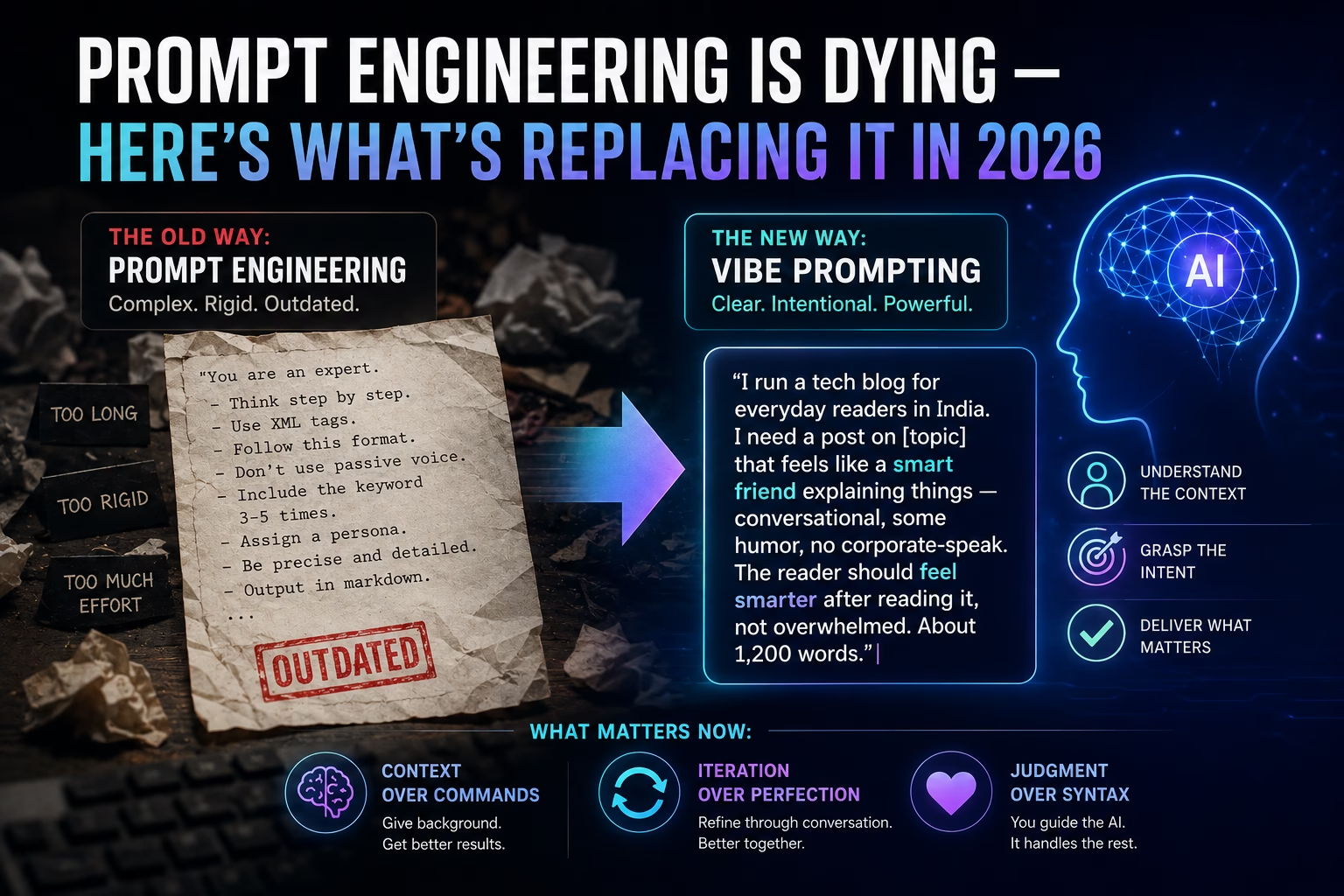
Remember when "prompt engineer" was being floated as the hottest job of the decade? There were courses, bootcamps, entire YouTube channels dedicated to teaching you the exact syntax to coax a good answer out of ChatGPT. Well — a lot of that advice is either becoming irrelevant, or already is.
"Add 'think step by step' at the end." "Assign it a persona." "Use XML tags for structure." Not because AI got worse — but because it got dramatically better. And the way you communicate with it needs to catch up.
This isn't a doomer post. You're not wasting your time by learning to use AI well. But how you use it is changing fast, and if you're still prompting like it's 2023, you're probably getting results that are... fine. Not great. Just fine. Let me explain what's actually happening.
What "Prompt Engineering" Actually Meant
At its peak, prompt engineering was about exploiting the quirks and limitations of early language models. Models like GPT-3 and early GPT-4 were essentially very sophisticated autocomplete — they predicted the most likely next token based on your input, and nothing more.
That meant your job, as the human, was to game the system. You had to give the model enough context that it could predict the right kind of continuation. Want a structured output? You had to manually model that structure in your prompt. Want it to reason before answering? You had to literally instruct it to "think step by step" — because without that cue, it'd skip straight to an answer, often wrong.
Prompt engineering was essentially a workaround for a model that had no internal "thinking" phase. You were doing the reasoning scaffolding for it.
What Changed — Reasoning Models Broke the Rules
Then came OpenAI's o1, followed quickly by reasoning-capable versions from Anthropic, Google, and others. These models don't just predict the next token — they actually generate intermediate reasoning steps before giving you an answer. They "think" before they respond, often spending several seconds or even minutes working through a problem internally.
Early language models like GPT-4 generated answers directly — you asked a question, and the model started producing text token by token. Newer models changed this by spending time "thinking" before answering, generating intermediate steps and then producing the final response.
You don't need to tell a reasoning model to "think step by step" — it already does. You don't need to manually break a problem into sub-tasks — modern models handle multi-step logic internally. The complexity moved inside the model. That freed you — sort of.
A lot of the old prompt tricks stop mattering. The elaborate formatting techniques to get structured output? Most frontier models now follow formatting instructions reliably without you needing to demonstrate the format in your prompt. The whole "assign it a persona" ritual? Optional at best, theatre at worst.
So What's Taking Over? "Vibe Prompting" Is Real (And It Works)
Here's my honest observation after using these tools almost daily: the people who get the best results from AI in 2026 aren't the ones who write the most technical prompts. They're the ones who communicate most clearly. And those are genuinely different things.
I've started calling it "vibe prompting" — and before you roll your eyes, hear me out. It's not about being lazy or vague. It's about communicating intent, context, and constraints the same way you'd brief a smart colleague. Not a robot. Not a search engine. A person who's capable but needs to understand why you're asking, not just what you're asking.
The shift looks like this in practice:
The second prompt is shorter, less technically rigid, and honestly gets better results from modern models because it communicates intent rather than instructions. The model can figure out what H2 headings are — what it needs from you is the why.
"The AI got smarter. Now it's your clarity — not your syntax — that's the bottleneck."
— warisweb.comThe Three Things That Actually Matter Now
If prompt engineering as a rigid technical discipline is fading, what should you actually focus on? Here's what's working right now:
1. Context Over Commands
Modern AI models are extraordinarily good at inferring what you need — if you give them enough context about your situation. Who are you? Who's the audience? What's the goal? What would a bad output look like? These questions matter more than whether you use specific phrasing tricks.
The most useful thing you can add to any AI request in 2026 is: "The reason I'm asking this is..." followed by an honest explanation. Watch how much better the outputs get.
2. Iteration Over Perfection
The old mentality was: write the perfect prompt, get the perfect output in one shot. That was partly a limitation of cost and speed — early API calls were slow and expensive, so you tried to nail it in round one.
Today, going back and forth with AI is fast, cheap, and encouraged. Your first prompt is a draft. You respond to the output, push back, ask it to change tone, make it shorter, ask it to argue the opposite — the model holds context and refines. What matters now is orchestration: combining models, tools and workflows, not crafting one perfect input.
Less like filling out a form, more like having a conversation. Which — if you think about it — is how you get things done with actual people too.
3. Goal-Setting Over Step-by-Step Instructions
AI is entering a new phase defined by real-world impact — moving beyond answering questions to collaborating with people and amplifying their expertise. That means the best use of AI now isn't giving it a task list. It's giving it a goal and letting it figure out the path.
Instead of "write an intro, then three body sections, then a conclusion," try "write a post that makes someone who knows nothing about X feel confident they understand it by the end." Goal-first, structure-second. The model handles the scaffolding; you steer the destination.
What This Means for You Practically
If you use AI for work — writing, coding, research, customer communication, anything — here's the honest practical takeaway:
You don't need to become a prompt engineering expert. You do need to become a better communicator. Which, somewhat annoyingly, is a skill that takes longer to develop and can't be reduced to a list of syntax tricks.
The people who are going to use AI most effectively in the next few years are the ones who know how to:
- Articulate what they actually want (harder than it sounds)
- Give useful feedback when the output misses the mark
- Know when to be specific and when to stay intentionally open-ended
- Recognize a good output from a mediocre one
AI can generate confident-sounding rubbish just as easily as genuinely useful content. The human skill of quality judgment isn't going anywhere — it's just going to matter more, not less.
Here's What I Actually Think
Prompt engineering as a formal discipline had its moment, and it was a useful one. It forced people to think precisely about what they wanted and how to communicate it — skills that carry over even as the techniques evolve. But the framing of it as a specialized career skill — something you'd put on your LinkedIn, a discrete technical ability separate from the work itself — that's going to fade. What will remain is something older and less glamorous: the ability to think clearly, communicate well, and know what good looks like.
IBM's Distinguished Engineer summed it up well: "I think we will all become AI composers — whether you're a marketer, programmer or PM." The composer analogy is right. You don't need to understand every instrument's mechanics. You need to know what the music should sound like.
The Takeaway
Prompt engineering isn't dead — it's evolving. The rigid, syntax-heavy, trick-based version is fading because models have advanced past needing it. What's replacing it is something more human: communicating your intent clearly, iterating in conversation, and staying focused on goals rather than methods. Skip the prompting cheat-sheet rabbit holes. Practice explaining things clearly, giving useful feedback, and knowing what you actually want. That's the skill that ages well — regardless of what the next model update brings.
Frequently Asked Questions
Everything you wanted to know about prompting AI in 2026.