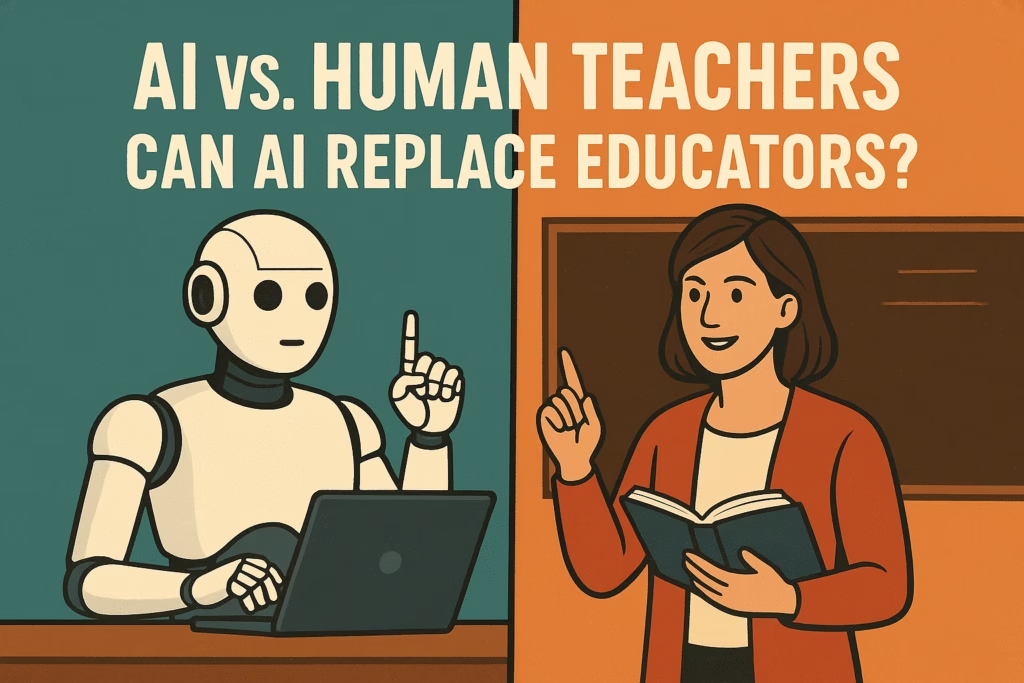
Half of all educators are now using AI to help create lesson plans, and 58% of university instructors use generative AI in their daily practice. But here's the real question everyone's asking: does this mean AI can actually replace teachers? Spoiler alert: it's complicated.
Walk into a classroom today, and you might see something that would've seemed like science fiction a decade ago: students getting instant feedback from AI tutors, teachers using algorithms to identify struggling learners before they fall behind, and personalized lesson plans generated in seconds rather than hours.
The Rise of AI in Education
The global AI market in education was valued at approximately $5.88 billion in 2024 and is projected to grow at a compound annual growth rate of 31.2%.
Duolingo uses AI to adapt language lessons to your learning pace — get something wrong repeatedly, and the app notices, giving you more practice on that specific concept. Khan Academy's AI tutor (Khanmigo) can explain math problems step-by-step, answer questions, and even help with essay writing — all in a conversational way that feels surprisingly human. ChatGPT and similar tools have become study companions for millions of students. Adaptive learning platforms in schools track every answer a student gives and adjust the difficulty in real-time, something impossible for a teacher managing 30 students simultaneously.
Around 74% of districts plan to train teachers on AI by Fall 2025, showing this isn't just a tech experiment — it's becoming standard practice.
Benefits of AI in Education
In a traditional classroom, a teacher has to aim for the middle — not too easy, not too hard — because they're teaching 25-30 different students at once. AI doesn't have this problem. Adaptive algorithms can customize lessons based on each student's performance, learning speed, and even the types of mistakes they're making. It's like having a tutor who has infinite patience and never gets tired.
Remember waiting a week to get your essay back? AI eliminates that anxiety. Quizzes can be graded instantly. AI can analyze essays for grammar, structure, and even argument quality in seconds. This immediate feedback loop is actually really valuable for learning — research shows the faster you get feedback, the better you learn.
Students in remote areas without access to specialized teachers can learn from AI tutors. Kids learning in their second or third language can get instant translation and explanations in their native language. Students with disabilities can use AI tools that adapt to their specific needs. Education becomes less about where you live or what resources your school has, and more about your willingness to learn.
AI, once developed, can scale almost infinitely — one AI tutor can theoretically help millions of students simultaneously, with essentially zero marginal cost per additional student. For developing countries or underfunded school districts, that math is pretty compelling. This doesn't mean AI is cheaper than teachers because it's better — but when faced with a choice between 100 students per teacher with no AI, or 30 students per teacher with AI support, the economics start making sense.
Limitations of AI in Education
This is the big one. AI can process data, recognize patterns, and generate responses. What it can't do is genuinely understand human emotions, provide real empathy, or recognize when a student is struggling with something that has nothing to do with academics. Teachers with high emotional intelligence are good at engaging students in learning activities, which has a positive impact on student learning outcomes. They see when a kid is having a bad day, notice when a usually chatty student goes quiet, understand that the student "acting out" might be dealing with problems at home. AI can't mentor you through your first heartbreak, can't inspire you with passion for a subject because they genuinely love it, and can't look you in the eye and say "I believe in you" in a way that actually changes how you see yourself. Creating a sense of emotional safety for students is central to learning — and that's something AI fundamentally cannot provide.
"You can't download inspiration. You can't program passion."
— warisweb.comWhen we hand off more and more of education to AI, we risk reducing the human interactions and creative thinking that make learning meaningful. Studies indicate AI systems could inadvertently disclose personal information, but beyond privacy, there's a deeper concern about what happens when students become too dependent on AI assistance. If students always have an AI to explain things, do they lose the ability to struggle productively with difficult concepts? Some of the most valuable learning happens when you're stuck — when you have to really think, try different approaches, make mistakes, and figure it out yourself.
AI education tools collect enormous amounts of data: what students know, how they learn, where they struggle, how long they spend on each problem. Concerns over bias in AI models increased from 36% in 2023 to 49% in 2024 among faculty and administrators. Concerns about data privacy and security of AI models also rose, from 50% to 59%. Who owns that data? Could it be sold to advertisers? And then there's algorithmic bias — AI systems trained on data will perpetuate and possibly amplify existing biases (racial, socioeconomic, gender-based), potentially directing students toward or away from certain opportunities. Respondents expressed fears over data misuse, unauthorized access, and the potential for AI to facilitate plagiarism and undermine critical thinking.
The Unique Value of Human Teachers
Emotional support and mentorship go way beyond just explaining concepts. Teachers are often the first to notice signs of abuse, mental health struggles, or family problems. They provide a stable adult presence for kids who might not have that at home. A teacher doesn't just teach math or history — they teach what it means to be a thoughtful, engaged human being.
Critical thinking and creativity development require more than presenting information and checking answers. Great teachers ask provocative questions that don't have clear answers, create classroom discussions where students wrestle with ambiguity, assign projects that are messy and open-ended, encourage students to make creative leaps and take intellectual risks.
Role models beyond academics might be the most underappreciated aspect of teaching. Teachers show students what passionate engagement with ideas looks like, demonstrate intellectual humility ("I don't know, let's figure it out together"), model ethical behavior and conflict resolution. For many students, especially from disadvantaged backgrounds, teachers are the only college-educated professionals they regularly interact with — that representation matters enormously.
Future of Education – Collaboration, Not Replacement
The future of education isn't AI versus teachers. It's AI working alongside teachers, each doing what they do best. AI as the teaching assistant who never gets tired, handling repetitive tasks — grading, tracking progress, creating customized practice problems, managing administrative paperwork. Meanwhile teachers do what only humans can do: building relationships, providing mentorship, facilitating meaningful discussions, noticing when something's wrong, inspiring curiosity.
AI handles initial instruction and practice for new concepts, students work at their own pace, and AI identifies exactly who's struggling with what. The teacher then has real-time data showing them where to focus attention. Class time becomes less about lecturing and more about discussion, application, creative projects, and relationship-building.
50% of educators are utilizing AI technologies to assist with creating lesson plans, freeing them up to focus on the human elements of teaching. This isn't about replacing teachers — it's about empowering them to be more effective by removing the parts of their job that don't actually require a human touch.
Conclusion
So, can AI replace human teachers? The short answer is no — not even close. AI is transforming education in powerful ways: personalized learning at scale, instant feedback, increasing accessibility, handling time-consuming administrative tasks. These are real, significant benefits. But AI cannot replace the emotional intelligence, mentorship, inspiration, and human connection that makes teaching powerful. It can't notice when a student is struggling with more than just academics. It can't inspire curiosity through genuine passion. It can't look a kid in the eye and say "I believe in you" in a way that changes their life.
The future of education isn't about AI versus teachers — it's about AI and teachers working together. Technology handles what it does best: personalization, instant feedback, data analysis, administrative tasks. Teachers focus on what only humans can provide: emotional support, critical thinking development, mentorship, and inspiration. That's not a compromise. That's actually the best possible outcome. The question isn't whether AI will replace teachers — it's how we can use AI to make teachers more effective, give them more time for meaningful human connection, and help every student get the personalized attention they deserve.
Frequently Asked Questions
Everything you wanted to know about AI's role in the classroom.