Let me describe something that probably happened to you recently. You typed a question into Google, scrolled past an AI Overview and a wall of ads, clicked an article that turned out to be padded filler, hit the back button, tried another result, and finally found something useful about four minutes later.
Then a colleague mentioned they just ask ChatGPT and get the answer in seconds.
And now you're wondering whether you've been doing this wrong the whole time.
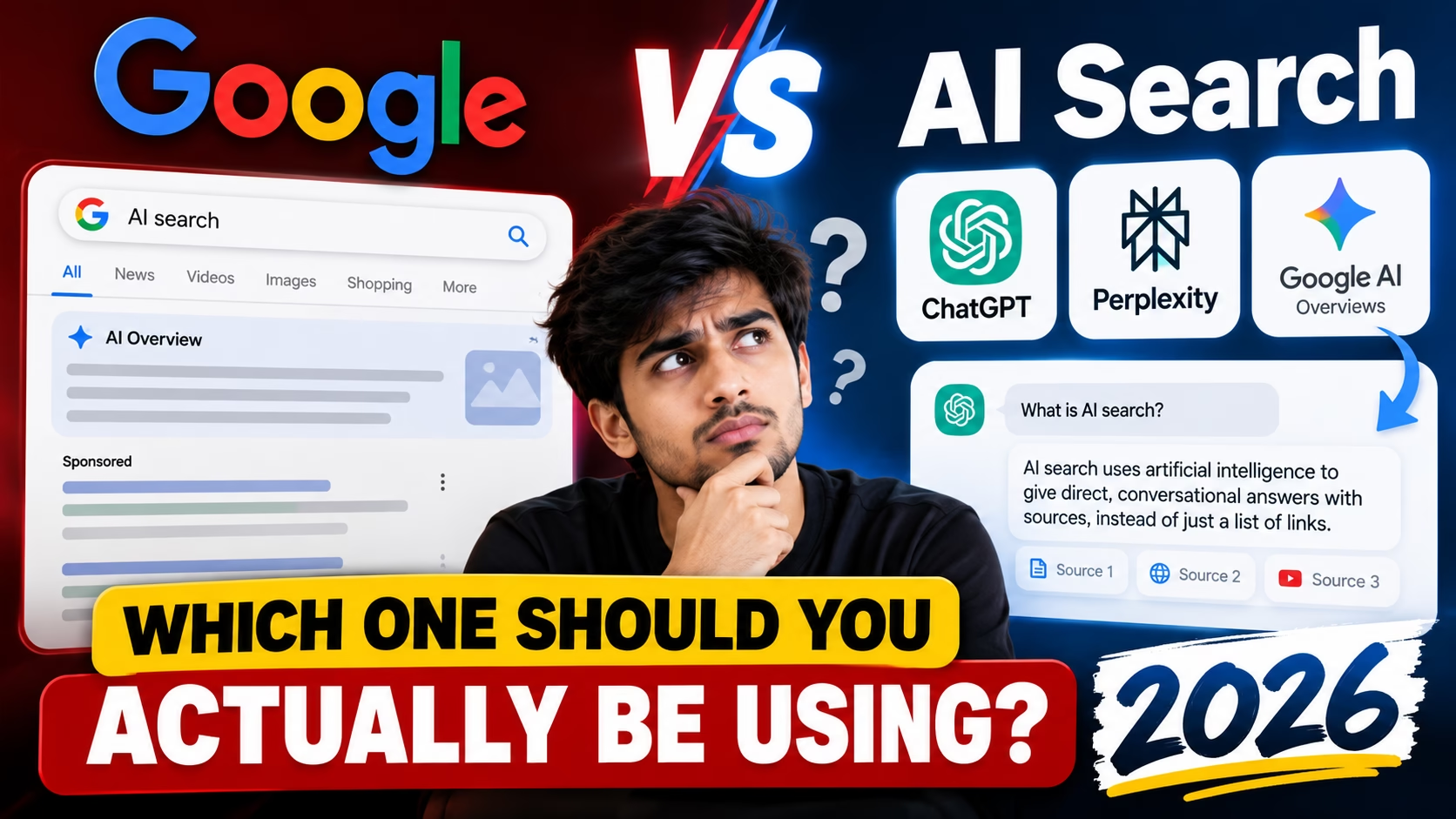
Here's the honest answer: sometimes yes, sometimes no. AI search has gotten good enough that it's the smarter first stop for a lot of things you'd automatically Google. But dropping Google entirely and opening Perplexity for everything is also a mistake. They're different tools with different strengths, and the people getting the most out of search in 2026 aren't picking a side. They know which one to open first.
This post breaks that down practically. No jargon, no SEO theory. Just what to use when, and why.
The Numbers First, Because They're Actually Interesting
ChatGPT crossed 1 billion active users in May 2026, making it one of the fastest-growing apps ever. By one estimate from Graphite, it now accounts for around 20% of search-related traffic worldwide. Perplexity, the dedicated answer engine, has carved out a solid slice of its own, and Google's built-in AI features (AI Overviews and AI Mode) now appear on roughly 30% of queries.
And yet Google still handles around 88% of global search traffic.
Those facts seem contradictory until you notice that people aren't swapping Google out. They're stacking tools on top of it. The same Graphite research found that after people started using ChatGPT, their weekly Google sessions actually went up, from about 10.5 to 12.6. Searching more in one place makes you search more everywhere.
What's changing isn't whether people use Google. It's what they use Google for.
What AI Search Is Actually Better At
Research and "explain this to me" questions
AI winsThis is where AI search has clearly won. If you're trying to understand a concept, compare two things, or get a summary of something complicated, an answer engine will usually beat ten blue links.
"What's the difference between a mutual fund and an index fund?" Ask Google and you get ten articles, each 2,000 words long, each starting with "Great question!" Ask Perplexity or ChatGPT and you get a direct answer in three paragraphs, with citations you can check.
Same for how-to research. "How does VPN split tunneling work?" "What should I know before hiring a freelancer for the first time?" These are questions where you want an answer, not a reading list.
Follow-up questions
AI winsGoogle is a one-shot tool. You type, you get results, you start over. A conversational tool remembers where you are. You can ask "explain cloud storage," follow up with "what's best for someone who just needs to back up phone photos," then "which of those works well on Android?" and it holds context through all three. That flow is a genuinely different kind of useful.
Pulling many sources together
AI winsPerplexity is especially good at this. Ask it to compare five smartphones and instead of opening five review sites, you get one synthesised answer with inline citations, so you can verify anything that sounds off. Research that used to take twenty minutes takes about two.
What Google Is Still Better At
Anything local
Google wins"Best biryani near Moradabad." "Electrician near me." "Pharmacy open now." Google has Maps data, business listings, live hours, and reviews that AI tools can't match. No chatbot is reliably telling you which dhaba is open on a Sunday evening. Google is.
Navigational searches
Google winsIf you already know where you want to go ("IRCTC login," "Amazon India return policy"), just type it into Google. You want the actual website, not a summary of it.
Shopping and price comparison
Google winsAI can give you buying advice ("what to look for in a budget laptop"). But for "every laptop under ₹50,000 right now, sorted by price," Google Shopping still wins.
Breaking news and live data
Google winsCricket scores, stock prices, something that happened an hour ago: Google or a news app is the right call. AI tools are catching up on freshness, but they aren't there yet.
What About Google's Own AI?
Google has been pushing AI into its own results hard. AI Overviews sit at the top of a lot of searches, and AI Mode gives you a full conversational interface inside Google.
Here's my honest take. AI Overviews are handy for a quick summary, but they got a rough reputation early on after some very public errors, and trust hasn't fully bounced back. AI Mode is more interesting. It's closer to Perplexity than to classic Google, and if you already live in Google's world, it might be all you need.
My working rule: if I'm already in Google and want a quick AI answer, I use AI Mode. If I want the best research experience specifically, I open Perplexity or ChatGPT.
Three Everyday Scenarios
Here's how the split plays out in real life.
You're planning a three-day trip to Goa on a budget. Start with an AI tool. "Plan three days in Goa under ₹15,000, I don't drink and I like quiet beaches" gets you a sensible draft itinerary in one go, and you can keep tweaking it. Then switch to Google for the actual hotel listings, current prices, and Maps directions.
You need a new laptop for college. Ask Perplexity what specs matter for your course and budget, because that's an explanation problem. Then use Google Shopping to find who's selling the exact model cheapest this week, because that's a lookup problem.
You've got a strange rash and it's 11pm. Use either one to understand what the common causes might be, but treat it as background reading, not a diagnosis. For anything that worries you, a doctor beats any search box.
Notice the pattern: AI for understanding, Google for locating. Once you see it, you can't unsee it.
A Practical Cheat Sheet
Here's how I'd split it, in plain terms:
Open Perplexity when you're researching. Understanding a topic, comparing options, getting an answer with sources you can click.
Open ChatGPT when you're thinking something through. Complex questions, back-and-forth, anything where you're working toward a conclusion rather than looking up a fact.
Open Google when you know where you're going. Local, navigational, shopping, live results.
Use Google's AI Mode when you're already there. Don't switch apps for every question if the answer in front of you is good enough.
Here's What I Actually Think
"AI vs Google" is a bit of a false war. These tools solve different halves of the same problem, finding information and making sense of it. And every time a new tool shows up, someone declares Google dead. They've been declaring it for a long time.
What's actually happening is more interesting: the meaning of "search" is expanding. For twenty years it meant typing keywords and getting links. Now it also means getting answers, summaries, and conversations. Google is one way to do that. Perplexity and ChatGPT are another. They're more complementary than competitive.
The skill worth building isn't loyalty to one tool. It's knowing which one fits the question in front of you, and that instinct builds fast. Give it a week. Research question, AI tool. Local or "take me to this site," Google. By day seven you'll stop thinking about it.
The Takeaway
AI search is good enough now that you're leaving time on the table if you haven't tried it. For research, comparisons, and conversational questions, it's often faster and clearer than clicking through results.
But Google isn't going anywhere, and it's still the right tool for a big chunk of what you search daily. The answer isn't switching. It's widening your toolkit and knowing which one to reach for.
Start with Perplexity for your next research question and Google for your next "where do I find this." That's really all there is to it.
Frequently Asked Questions
Everything you wanted to know about AI search versus Google.