Merriam-Webster — the dictionary people, the ones who've been deciding what words mean since 1828 — named "slop" their Word of the Year for 2025. Not "agentic." Not "hallucination." Not even "vibe." Slop.
That says everything about where we are right now.
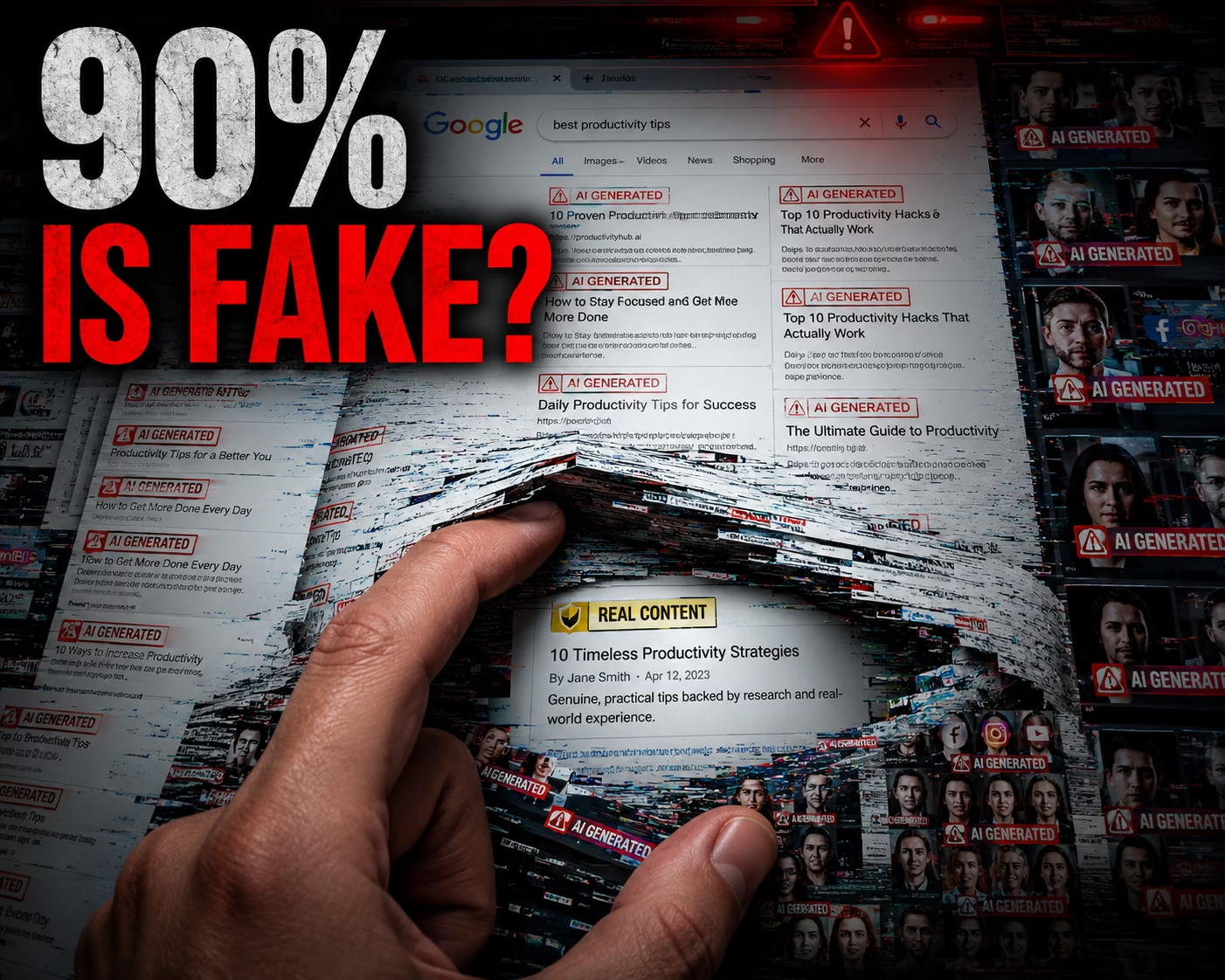
If you've noticed that Google searches feel weirder lately, that product reviews sound oddly similar to each other, that half the articles you open feel like they were written by someone who read three other articles about the same topic and then blended them in a blender — you're not imagining it. A report from April 2026 estimated that as much as 90% of all new web content is now AI-generated. Ninety percent. The front page of the internet is, increasingly, a hall of mirrors.
This post isn't a panic piece. AI tools aren't evil and this isn't going to end with "delete ChatGPT." But AI slop is a real, measurable problem that affects you every time you search for something, read a product review, or click a news headline — and knowing how to recognise it is genuinely one of the most useful digital skills you can have right now.
What Exactly Is AI Slop?
The definition is simpler than the discourse around it. AI slop is content — articles, social media posts, product descriptions, images, videos — that was generated by AI without any meaningful human input, judgment, or editing. The "slop" part isn't just about AI being involved. It's about the combination of high volume, low effort, and zero original value.
Think of it this way: a chef using a food processor to speed up prep work isn't making slop. A factory extruding ten thousand identical pre-formed patties to fill shelf space is. Same principle.
The economics are what make it so hard to stop. Creating an article used to require hiring a writer, editing it, fact-checking it, and publishing it — a process with natural friction that kept volume in check. With AI, a single person can now publish 200 articles a day. Some websites are already doing exactly that. The motivation isn't to inform you. It's to fill keyword gaps, game search algorithms, and collect ad revenue or affiliate clicks from people who don't realise what they're reading.
Microsoft CEO Satya Nadella tried in January 2026 to get people to stop using the word "slop," calling AI output the "new equilibrium." Respectfully, Satya — no. When 90% of new web content is undifferentiated AI output, calling it an equilibrium is a bit like calling a flood a "new water equilibrium."
Why It's Gotten So Bad, So Fast
Three things converged at once to create the current mess:
Running an AI writing tool at scale costs almost nothing in 2026. The barrier to flooding the internet with content essentially disappeared.
Google's February 2026 Core Update specifically targeted AI slop and "scaled content abuse" — but for the years before that, search engines rewarded content that looked thorough and well-structured, regardless of whether it contained any original insight. AI is very good at looking thorough. So the incentive was to produce more of it.
On YouTube, Facebook, and TikTok, AI-generated posts that grab attention in the first two seconds perform exactly the same as human-created ones. The algorithm can't tell the difference. So the content that spreads fastest isn't necessarily the most accurate or useful — it's the most attention-grabbing, and AI can generate attention-grabbing content at industrial scale.
A 25% drop in traditional search volume by 2026 was predicted by Gartner — and it's increasingly borne out by actual data. People are leaving Google not because AI search is so great, but because traditional search results are so full of AI content that they've stopped being trustworthy.
How to Spot AI Slop in 30 Seconds
Here's the honest truth: there's no perfect AI detector. Tools that claim to detect AI-written content have accuracy rates that hover between "maybe useful" and "coin flip." But you don't actually need a detector. You need pattern recognition — and once you've got it, AI slop becomes almost immediately obvious.
AI-generated content is extraordinarily confident. It states things assertively. It has structure, subheadings, and bullet points. But read closely and you'll notice it never commits to anything specific. No actual data with a named source. No example from a named person or company. No "I tested this" or "I spoke to someone who..." Just broad, authoritative-sounding assertions that could apply to anything.
Real writing has texture. It has moments where the author says something unexpected, makes a joke that lands (or doesn't), or takes an opinion that someone else might push back on. AI writing is smooth. It flows well. It never says anything you'd disagree with strongly, because it was trained to avoid friction. If an article feels like it was designed to not offend anyone, about any aspect of any claim — that's your signal.
Google "how to do X" in any niche and open five results from different sites. If they all have the same approximate structure (intro, 5-7 subheadings, "key takeaway" section, FAQ at the bottom) — that's AI slop cross-pollinating itself. They're not copying each other; they're all just running the same prompt through the same model and publishing the output.
AI writing has a characteristic enthusiasm about its subject that no human writer would actually sustain for 1,200 words about, say, VPN settings. Phrases like "fascinating," "crucial," and "it's worth noting" (a massive tell) appear constantly. Real writers get tired of their topics, express mild frustration, or admit when something is boring. AI doesn't.
This one's more for social media than articles. AI-generated images in 2026 are very good, but they still struggle with hands (count the fingers), backgrounds (look for objects that blend weirdly into each other), and text overlaid on images (letters that don't quite form real words). If you're suspicious of an image, zoom in on the hands or any written text in the frame.
The Part That Actually Worries Me
Here's my honest take on this whole situation: the individual pieces of AI slop aren't the problem. Any single mediocre article is easy to close and ignore. The problem is what happens to information at scale when most of it is AI-generated.
AI models are trained on internet text. If 90% of new internet text is now AI-generated, future models are going to be trained increasingly on AI-generated content. Researchers have a term for this: model collapse. The diversity of information slowly compresses. The long tail of niche expertise, local knowledge, and genuinely original perspectives — the stuff that made the internet valuable in the first place — gets drowned out.
"Think of it like a photocopy of a photocopy of a photocopy. Each generation loses a little fidelity. The facts start drifting. The nuance disappears. The confidence remains."
— warisweb.comWe're not there yet. But the trajectory matters.
What You Can Actually Do About It
You can't fix the internet. But you can navigate it better:
The Bigger Picture
AI slop is what happens when a powerful tool gets used at scale without thought for the consequences. That's not new — it happened with spam email, clickbait headlines, and SEO keyword stuffing. Each time, the internet eventually adapted, though never quite back to what it was before.
The difference this time is the scale and the speed. We went from "AI can write" to "90% of new web content is AI-generated" in about three years. The adaptation period is going to be messier than previous ones.
The signal value of human writing, original research, and first-person expertise just went up significantly. When most content is average-to-mediocre AI output, anything with actual human judgment, specific experience, or genuine opinion becomes easier to find and more valuable when you do. The noise floor rose. The ceiling didn't. The internet isn't dying. It's sorting itself. Learning to navigate that sort is the skill that matters right now.
Frequently Asked Questions
Everything you wanted to know about AI slop and how to avoid it.